
Are We Lucky?
Further thoughts on the Hallett inquiry's second report... (I'll stop whining eventually...)

***A version of this article was generously published yesterday by Café Americain. You can read it 👉 here 👈. There is some overlap with my recent piece for The Critic (read it 👉 here 👈), but the overall argument is different and, as I explain below, is not a criticism of lockdown-till-vaccine.***
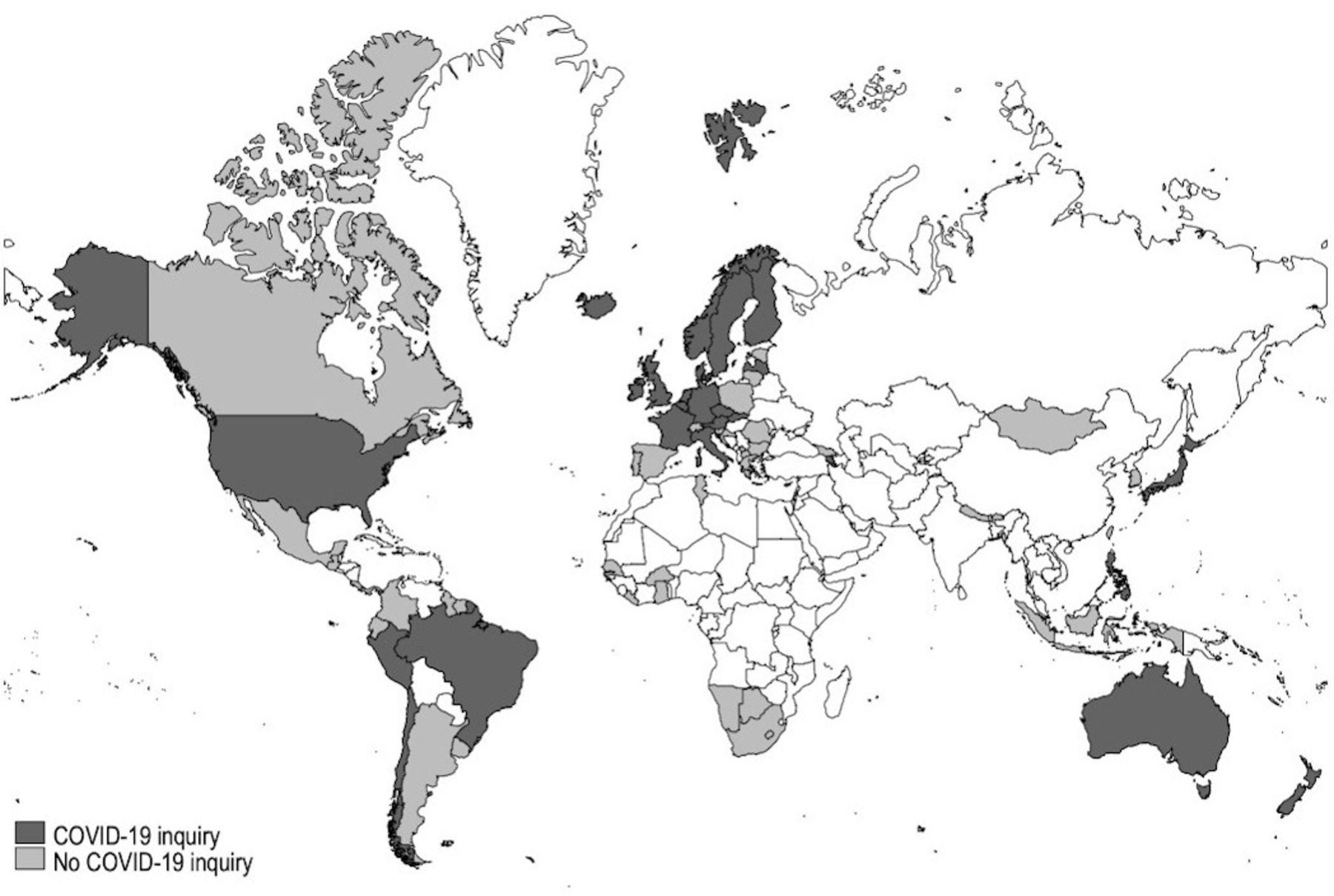
Some months ago, our exploratory study of national COVID-19 inquiries was published in the BMJ Public Health (you can read it 👉 here 👈). In it, we found that only under a third of democracies (32%), including Great Britain, are holding at least one state-backed inquiry into their handling of the COVID-19 pandemic. Although I had already gone on the record as a skeptic of Baroness Hallett’s inquiry into the British government’s response to and impact of the Covid-19 pandemic, collecting the data for this study brought me to appreciate its unusually broad scope and detail. This led me to conclude, with tentative optimism, that we in Britain were lucky, because the debates over the politics of lockdown-till-vaccine were, however imperfectly, being kept open at the highest levels of officialdom. Dipping in and out of the recently published second report, however, I find myself reverting to my earlier scepticism.
There are probably many reasons for cynicism—not least, the report’s frustrating claim that lockdowns were “inevitable”—but I would like to focus on just one here: Hallett’s portrayal of scientific facts and advice. Let me start by making a couple of basic sociological points. First, bundles of scientific facts and advice are not dropped into government’s lap by the gods. They are produced by particular groups of experts, with particular incentives, working within particular intellectual traditions, and so making particular assumptions and value-judgements. Second, this means that much of the time, the particular fact-advice bundle that a government has to reckon with might have looked very different had it been produced by a different group of equally expert people.
To preempt the usual bitching, let me also be clear that, with these points, I am not endorsing full-blown scientific or epistemic relativism, but am rather insisting on something much less controversial: that the contents of our attempts to make sense of the world (such as bundles of scientific facts and advice) are largely contingent on their context of articulation (on a particular group of scientists actually doing particular things in particular ways), and that our efforts to describe and evaluate those attempts must foreground this contingency. Based on what I have read so far, however, it seems to me that Hallett is simply failing to do this.
To see how, consider her presentation of two influential scientific fact-advice bundles produced in March 2020: Professor Steven Riley’s note (considered on March 11th, 2020) and the infamous Report 9 (considered on March 16th, 2020). Of the former—described as “the first time that a lockdown, as it became known, had been ‘seriously considered’ [i.e., modelled?] as a possible intervention” (Vol.1, p.133)—she writes that,
“SPI-M-O met on March 11 2020. It discussed the paper dated 9 March from Professor Riley, which set out reasons for the UK not to delay closing schools, to move to working from home and to implement any other possible social distancing, with a suggested initial three-week duration of additional interventions. He also suggested that the perceived benefits of slowing the spread of the virus [in this context, cocooning-style mitigation] might not be achieved if NHS critical care was overwhelmed and the public voluntarily began to socially distance as a result”. (Vol.1, p.133)
And of the latter—described by its lead author Professor (now Sir) Neil Ferguson as “a significant pivot towards advising rapid introduction of more intensive [interventions]” (Vol.1, p.173)—she writes that,
“At this meeting, SAGE considered Imperial College London’s Report 9: Impact of Non-Pharmaceutical Interventions (NPIs) to Reduce COVID-19 Mortality and Healthcare Demand, which advised that suppression was now ‘the preferred policy option’. The report concluded that restrictions designed only to slow the spread of Covid-19, such as self-isolation, household isolation and social distancing of the elderly and others at most risk of severe diseases (shielding), would be likely to lead to ‘emergency surge capacity limits of the UK … healthcare systems … being exceeded many times over’ and about ‘250,000 deaths’ in Great Britain. However, it noted that implementing stringent restrictions designed to stop the spread of the virus would be challenging as they would need to be maintained until a vaccine was available to avoid an exit wave. This could be in 18 months or longer”. (Vol.1, p.172)
To be fair, in the above, Hallett does the bare minimum of presenting these reports as authored products. But she does not go much further than this. She does not tell the reader what Riley and Ferguson actually did to produce their bundles. She does not, for example, really make it clear that Riley and Ferguson belong to the same tradition of disease modelling, that they made similarly pessimistic assumptions about the coof’s fatality rate (seemingly based on the same co-authored paper) and Our NHS’s critical care capacity’s inelasticity, or that both explicitly excluded economic impacts from the models on which they based their pro-lockdown advice. Likewise, she does not tell the reader that Riley made assumptions about spontaneous behaviour change based on studies of SARS-1, MERS, and Ebola (all very different outbreaks to the looming SARS-2) or that he drew his damning conclusions about cocooning from a model run that did not stratify the population by age or spatial distribution (i.e., precisely what cocooning proposed to do).
This erasure of scientific production continues in Hallett’s presentation of the scientific facts which it has produced. She tells the reader that modelling has “established” that, had a mandatory lockdown been imposed a week earlier, the number of deaths in England in the first wave would have been reduced by 48%. But she does not set out said modelling’s various assumptions about infection rates, incubation periods, and case-to-case intervals. Hallett also peppers her story with updates on the number of COVID-19 cases and deaths, but never explains how either of these were defined, by whom, how the data were collected and processed, or how those definitions and collection and processing methods changed over time and affected the government’s decisions.
This is not, per se, a complaint about the particular actions and decisions taken by the particular scientists in question. For one thing, I believe that forcibly “cocooning” the elderly and clinically vulnerable would be state-mandated elder abuse and so am not especially fussed—at least, morally—by Riley’s criticisms of the policy. My specific complaint here is that, in obscuring the scientific fact-advice bundles’ context of articulation, Hallett is failing to fulfill one part of her mandate (to “produce a factual narrative account”) while imperilling the other (“identify the lessons to be learned”). Hallett’s current approach does not provide readers with a factual narrative account of what the scientists actually did, of how others could and would have done things differently, and so precludes systematic reflection on how to better manage contingency in scientific advice next time. Why, in a free and plural society, should one school of modelling’s pessimism, single-minded focus on disease transmission, and readings of past epidemics go unchallenged by competing perspectives?
Ultimately, I am not entirely disheartened (there is, it must be said, plenty of valuable detail in Hallett’s report and she alludes to some of the problems with the scientific advice), but my tentative optimism about an intelligent debate over science’s role in modern politics is gone. Science is something that people do, and so the proper register for an inquiry of this sort is critical—but not outrightly hostile—sociology of science. Hallett’s current approach reinforces the dominant science-worshipping—and therefore scientist-worshipping—tendency in our public culture. She could benefit from a little more Foucault in her life.

I wouldn't call this whining and I don't think you should either. Not everyone can, or has the time to, do the kind of analysis and synthesis you're able to do. With the amount of gaslighting going on, your voice is very important. It is very necessary to constantly and consistently call out "experts" who have vested interests.